AI Tools and Large Language Models in 2026: How to Choose the Best, Safest and Most Appropriate Systems
A scientific selection guide for general use and the priority sectors of the Institute of Digital Economy
Hovhannes Adajyan · June 26, 2026 · 35 min read
Abstract
A scientific and practical guide to choosing general-purpose and specialized AI systems, with detailed attention to Agriculture, Environment, Healthcare and Law, as well as research, coding, media, translation, automation and private deployment.
AI Tools and Large Language Models in 2026
How to Choose the Best, Safest and Most Appropriate Systems
Research and selection guide: This publication is not a product endorsement, medical opinion, legal opinion, or substitute for qualified professional advice.
Why this article was prepared
In the era of large language models, people and organizations face a practical problem: which AI tools are genuinely useful, which are appropriate for sensitive work, and what should each system be used for? The answer cannot be reduced to a single ranking. A model that is excellent for creative drafting may be unsuitable for confidential health records; a research assistant that supplies citations may still misrepresent them; and a specialist tool may outperform a general chatbot only when it is connected to reliable sector data.
This report turns those questions into a structured selection method. It expands the tool categories in the supplied sector report and keeps the Institute of Digital Economy’s four priority areas—Agriculture, Environment, Healthcare and Law—at the center of the analysis. It also adds scientific research, coding, media production, meetings and automation, translation, and local/private deployment.
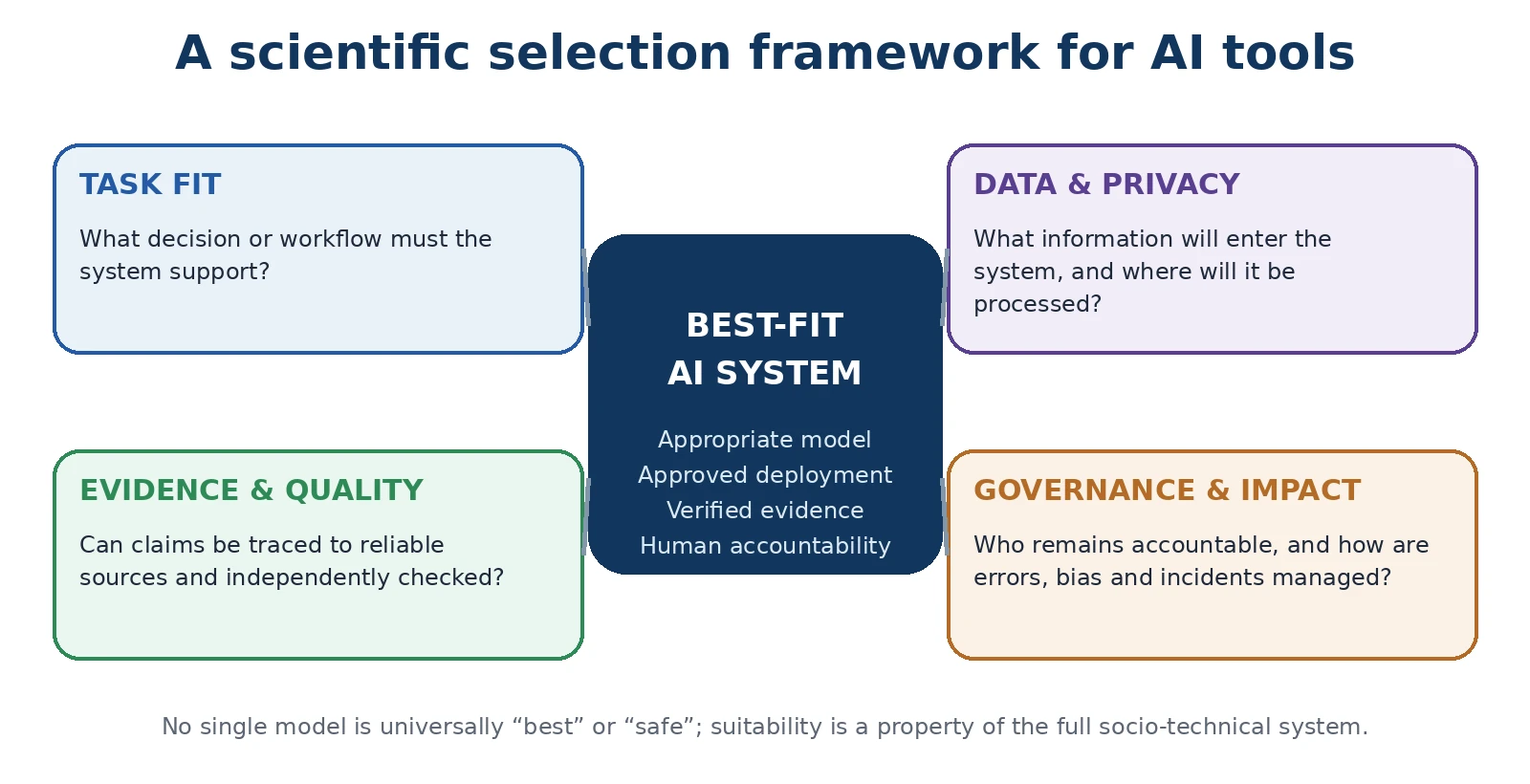
Central finding: The “safest AI tool” is not a brand. Safety is an outcome of the model, the deployment environment, the data entered, the evidence base, the human review process and the consequences of error.
Scope and limitations
- Product descriptions are based primarily on official vendor, institutional and research sources available in June 2026.
- The report does not reproduce fragile benchmark leaderboards or rapidly changing token prices. Access and pricing are summarized qualitatively and must be verified before procurement.
- No proprietary hands-on benchmark was conducted. Recommendations are decision-support guidance, not certification of safety, accuracy or legal compliance.
- Sector tools are included because of their relevance and maturity, not as an exhaustive market catalogue or endorsement.
1. Executive summary
Large language models have become a horizontal digital infrastructure: they can draft text, search and synthesize information, analyze files, generate code, interpret images, transcribe speech and connect with organizational systems. At the same time, domain-specific products are embedding these capabilities into farming, environmental science, clinical documentation and legal research. The result is not one AI market but a layered ecosystem of general models, sector applications, data platforms and workflow agents.
For most knowledge workers, ChatGPT, Claude, Gemini and Microsoft 365 Copilot are the most broadly useful starting points, while Perplexity is particularly useful for source discovery, DeepSeek and Mistral offer cost or deployment flexibility, and Grok is oriented toward current and social-information workflows. None should be treated as an authority by itself. Output quality is task-dependent, and all systems can hallucinate, omit context or reproduce bias.
In regulated or high-impact areas, specialist tools should be preferred when they provide authoritative databases, sector workflows, contractual protections and auditability. Even then, specialization is not a guarantee. A scientific review of legal AI systems found material hallucination rates in specialized products, reinforcing the need to open sources and verify propositions rather than relying on interface-level citations. Healthcare guidance from the World Health Organization likewise emphasizes governance, stakeholder involvement and evidence of benefit before large multimodal models are used at scale.
For IoDE, the most appropriate strategy is a modular, evidence-grounded AI stack. General models can support drafting, translation, public communication and exploratory analysis. Sector tools should be used for specialized workflows. Sensitive knowledge should be processed through approved enterprise or local deployments. High-stakes recommendations must remain under qualified human responsibility.
Principal recommendations
- Select by task and risk, not by popularity. Start with the decision or workflow, then examine data sensitivity, evidence needs, compliance and integration.
- Separate public, internal, confidential and regulated data. Consumer accounts should not receive sensitive material by default.
- Require traceable evidence. A citation is only a pointer; the source must be opened, read and tested against the generated claim.
- Use human-in-the-loop controls proportionate to impact. Healthcare, legal, pesticide, environmental-compliance and public-policy decisions require qualified review.
- Pilot before scaling. Test the tool on Armenian-language content, local laws, local crop conditions and representative user groups.
- Avoid single-vendor dependency. Preserve data portability, maintain a model inventory and design workflows that can switch providers.
2. How the report evaluates AI systems
The report applies a practical scientific framework aligned with the risk-management logic of the NIST AI Risk Management Framework and its Generative AI Profile: govern the system, map the context, measure relevant risks and manage them over time. It also reflects OECD principles for trustworthy AI and the risk-based approach of the EU AI Act. For organizations interacting with EU markets or partners, most AI Act provisions become applicable on 2 August 2026, subject to specific exceptions and phased obligations.
| Criterion | Scientific and procurement question |
|---|---|
| Task fit | Can the system perform the exact workflow—drafting, retrieval, image analysis, clinical documentation, legal research, geospatial analysis or automation? |
| Evidence and accuracy | Does it cite authoritative sources, reveal uncertainty and permit independent verification? How does it perform on representative local cases? |
| Data protection | What data are collected, retained, used for training or transferred to subprocessors? Are enterprise contracts, encryption, regional controls and deletion available? |
| Accountability | Who approves outputs, handles incidents and remains responsible for decisions? Can actions and source use be audited? |
| Bias and inclusion | Does the system work across Armenian and other relevant languages, user groups, farm sizes, specialties, jurisdictions and accessibility needs? |
| Integration and maturity | Can it connect safely to existing systems, identity controls and approved knowledge? Is it a stable product, a research prototype or an early beta? |
| Cost and lock-in | What are the full costs of licenses, integration, evaluation, training, monitoring, switching and data export? |
Deployment suitability categories
| Category | Meaning |
|---|---|
| Institutional path available | The provider offers enterprise, healthcare, legal, cloud or self-hosted controls that may support sensitive use after contractual, security and compliance review. |
| Conditional use | Suitable mainly for non-sensitive work or controlled pilots. Data handling, evidence quality, jurisdiction or product maturity requires additional caution. |
| Experimental / research | Prototype or research-stage system. Do not use confidential data or rely on it for consequential decisions without independent validation and formal governance. |
Important distinction: A product may offer an institutional deployment path and still produce unsafe outputs. Conversely, a local model may keep data on site but remain insecure if the server is exposed, unpatched or poorly controlled.
Minimum evidence rule
For consequential work, every AI-supported conclusion should be accompanied by: 1) the source or data used; 2) the date and jurisdiction; 3) an uncertainty statement; 4) the responsible human reviewer; and 5) a record of material changes made after review.
3. Selection at a glance
The table below is a starting point, not an automatic procurement decision. “First tool to evaluate” means the most logical candidate for a pilot under the stated workflow and deployment conditions.
| Workflow | First tool(s) to evaluate | Alternative | Primary caution |
|---|---|---|---|
| General drafting and analysis | ChatGPT or Claude | Gemini / Mistral | Do not confuse fluent prose with verified facts. |
| Microsoft documents and meetings | Microsoft 365 Copilot | ChatGPT Business | Permissions and overshared files determine exposure. |
| Google Workspace and multimodal work | Gemini | ChatGPT | Consumer and enterprise data terms differ. |
| Current web research | Perplexity | ChatGPT search / Gemini | Open every cited source and check publication date. |
| Low-cost or self-hosted reasoning | DeepSeek or Mistral | Llama local stack | Security and maintenance shift to the deployer. |
| Smallholder agricultural advisory | Farmer.Chat | Plantix | Local agronomic validation and escalation are mandatory. |
| Commercial farm intelligence | AGRIVI or Farmonaut | Cropwise AI | Field data ownership and regional calibration matter. |
| Climate and environment Q&A | UNEP EnvironmentGPT | ClimateGPT / ChatClimate | Corpus boundaries and evidence freshness must be explicit. |
| Location-aware climate support | ClimSight | Custom RAG + geospatial data | Communicate uncertainty; not a deterministic forecast. |
| Clinical documentation | Abridge / Suki / Nabla | Dragon Copilot | Consent, contract, access control and clinician sign-off. |
| Broad healthcare AI platform | OpenAI for Healthcare | Cloud platform with approved models | General models are not validated diagnostic devices. |
| Legal research | CoCounsel / Lexis+ / Vincent | Harvey | Read primary authorities and confirm current status. |
| Contract review in Word | Spellbook | Harvey / CoCounsel | Apply playbooks and review every material redline. |
| Scientific literature synthesis | Elicit + Scite | Consensus / NotebookLM | Appraise study quality; do not rely on summaries alone. |
| Private document analysis | Approved enterprise workspace or local stack | Mistral/Llama self-hosted | Local deployment still needs patching, authentication and logs. |
IoDE selection rule: For public and low-risk work, usability and evidence access may dominate. For confidential or high-impact work, contractual controls, data location, authoritative sources and human accountability must dominate.
4. General-purpose LLMs
General-purpose systems are flexible “cognitive utilities.” They are useful for drafting, summarization, coding, translation, tutoring and exploratory analysis, but their breadth is also the reason they should not be mistaken for sector authority. The practical choice depends on ecosystem fit, context needs, deployment controls and the cost of error.
Sector-specific safety principle: Use these tools to accelerate work, not to remove accountability. For institutional data, use approved business, enterprise, API or private deployments and disable unnecessary connectors or retention.
| ChatGPT (OpenAI) | |
|---|---|
| Provider | OpenAI |
| Primary purpose | General-purpose reasoning, writing, coding, data analysis, search, voice and multimodal work. |
| Best for | A broad default assistant for drafting, synthesis, tutoring, prototyping and mixed-media workflows. |
| Strengths | Wide feature coverage; strong reasoning and tool use; flexible individual, business and enterprise deployment paths. |
| Limitations / risks | Outputs can be confidently wrong; web citations and calculations still need checking; features and limits vary by plan. |
| Safety and deployment | Use Business or Enterprise controls for institutional information. Keep confidential or regulated data out of consumer workspaces unless an approved policy explicitly permits it. |
| Access | Free and paid individual plans; business and enterprise plans; usage-based API. |
| Official link | OpenAI plans and business controls |
| Claude (Anthropic) | |
|---|---|
| Provider | Anthropic |
| Primary purpose | Long-document analysis, careful writing, software engineering and agentic workflows. |
| Best for | Policy analysis, document review, complex drafting, coding and tasks requiring sustained context. |
| Strengths | Strong long-form writing and coding; large-context workflows; enterprise security and data-retention options. |
| Limitations / risks | No model eliminates hallucinations; some multimodal and ecosystem functions differ from competitors; usage can be costly at scale. |
| Safety and deployment | Prefer Team or Enterprise for organizational material. Configure retention, access controls and approved connectors before uploading sensitive documents. |
| Access | Free and paid individual plans; Team/Enterprise; API. |
| Official link | Anthropic Enterprise |
| Gemini (Google) | |
|---|---|
| Provider | |
| Primary purpose | Multimodal assistance integrated with Google Workspace and Google Cloud. |
| Best for | Organizations centered on Gmail, Docs, Drive and Cloud; long-context and multimodal analysis. |
| Strengths | Native Workspace integration; broad model portfolio; strong cloud tooling, governance and developer ecosystem. |
| Limitations / risks | Data handling differs between consumer, Workspace and Cloud products; output quality varies by model and mode. |
| Safety and deployment | Use Workspace or Vertex AI configurations for institutional data. Review regional processing, connectors and administrator controls. |
| Access | Consumer tiers; Workspace editions; Vertex AI usage-based services. |
| Official link | Google Cloud data governance |
| Microsoft 365 Copilot | |
|---|---|
| Provider | Microsoft |
| Primary purpose | AI assistance embedded in Word, Excel, PowerPoint, Outlook, Teams and Microsoft 365 search. |
| Best for | Organizations whose documents, meetings and permissions already live in Microsoft 365. |
| Strengths | Works within existing identity, compliance and permission structures; strong productivity and meeting workflows. |
| Limitations / risks | Quality depends on Microsoft Graph content and permission hygiene; overshared files can produce overshared answers; licensing can be complex. |
| Safety and deployment | Enterprise data protection can keep prompts, responses and Graph data from foundation-model training, but administrators must still govern permissions, web search and agents. |
| Access | Copilot Chat and Microsoft 365 Copilot licensing; enterprise administration. |
| Official link | Enterprise data protection |
| Grok (xAI) | |
|---|---|
| Provider | xAI |
| Primary purpose | General reasoning, coding and current-information workflows, including access to X-related context. |
| Best for | Trend monitoring, rapid exploration, software tasks and users who value the xAI/X ecosystem. |
| Strengths | Fast model access; developer API; current-information orientation; business offering available. |
| Limitations / risks | Enterprise governance ecosystem is less mature than long-established cloud suites; real-time social data may amplify noise or manipulation. |
| Safety and deployment | Treat social content as unverified evidence. For organizational use, review business terms, retention and data-location requirements; do not use confidential data in unapproved consumer accounts. |
| Access | Consumer access through Grok/X; Business; API. |
| Official link | xAI privacy policy |
| DeepSeek | |
|---|---|
| Provider | DeepSeek |
| Primary purpose | Low-cost reasoning, coding and open-weight deployment options. |
| Best for | Cost-sensitive experimentation, research and teams able to self-host and secure open models. |
| Strengths | Open-weight options; strong value for reasoning/coding; local deployment can provide architectural control. |
| Limitations / risks | Hosted-service data sovereignty, jurisdiction and content-governance concerns; self-hosting transfers security and maintenance responsibility to the user. |
| Safety and deployment | Do not send regulated or state-sensitive data to the hosted service without a formal legal and security assessment. Self-hosting must include access control, patching, logging and model evaluation. |
| Access | Hosted chat/API and downloadable model weights, subject to model licenses. |
| Official link | DeepSeek API documentation |
| Perplexity | |
|---|---|
| Provider | Perplexity AI |
| Primary purpose | Search-first research with web retrieval and linked sources. |
| Best for | Current-information discovery, source finding, rapid landscape scans and question answering with citations. |
| Strengths | Source-linked answers; fast web research; enterprise search and knowledge features. |
| Limitations / risks | A citation does not prove that the cited source supports the exact claim; source quality and synthesis can still fail. |
| Safety and deployment | Use as a discovery layer, not a final authority. Open and inspect the underlying sources. Use Enterprise controls for private organizational data. |
| Access | Free and paid individual tiers; Enterprise offerings. |
| Official link | Perplexity Enterprise |
| Mistral Vibe / Mistral AI | |
|---|---|
| Provider | Mistral AI |
| Primary purpose | General assistance, coding and deployment of European commercial/open models. |
| Best for | European organizations seeking deployment flexibility, private infrastructure options or model choice. |
| Strengths | Cloud and self-deployment options; enterprise controls; efficient models; coding-oriented Vibe environment. |
| Limitations / risks | Capabilities and licensing differ substantially among models; self-deployment requires technical operations and security expertise. |
| Safety and deployment | Choose deployment and license according to data classification. Local or private hosting improves control but is not automatically secure. |
| Access | Consumer/business assistant, API and deployable models. |
| Official link | Mistral Vibe |
5. Agriculture
Agricultural AI combines language models with satellite images, weather, soil, farm records, crop images and agronomic knowledge. The main scientific challenge is localization: advice that is valid for one crop variety, climate zone or production system can be wrong elsewhere. Benefits therefore depend less on conversational fluency than on regional data, field verification and extension-service design.
Sector-specific safety principle: AI should support—not replace—farmers, agronomists and extension workers. High-impact recommendations on pesticides, irrigation, disease outbreaks and food safety require local evidence and qualified review.
| Farmonaut | |
|---|---|
| Provider | Farmonaut |
| Primary purpose | Satellite crop monitoring, vegetation indices, field alerts, irrigation and farm intelligence. |
| Best for | Farmers, agribusinesses, cooperatives and public programs that need field-scale remote sensing. |
| Strengths | Accessible satellite analytics; APIs; field monitoring and reporting without dedicated drone fleets. |
| Limitations / risks | Satellite resolution, cloud cover and model calibration limit plot-level conclusions; recommendations depend on local agronomy. |
| Safety and deployment | Treat geolocation and farm-production data as commercially sensitive. Validate alerts with field observations and qualified agronomists. |
| Access | Subscription and enterprise/API options; pricing varies by acreage and service. |
| Official link | Farmonaut platform |
| Farmer.Chat | |
|---|---|
| Provider | Digital Green and partners |
| Primary purpose | Multilingual, multimodal agricultural advisory for farmers and extension workers. |
| Best for | Smallholder support, extension services, NGOs and public advisory programs. |
| Strengths | Conversational delivery; local-language orientation; can be grounded in curated agricultural knowledge; designed for low-resource contexts. |
| Limitations / risks | Coverage and accuracy depend on the knowledge base, language and local agro-climatic conditions; connectivity and digital literacy matter. |
| Safety and deployment | Never present generic advice as a substitute for local experts, pesticide labels or emergency guidance. Establish escalation channels and monitor harmful recommendations. |
| Access | Program- and partnership-based deployments; public information and demos. |
| Official link | Farmer.Chat |
| AGRIVI | |
|---|---|
| Provider | AGRIVI |
| Primary purpose | Farm management, agronomic planning, traceability, weather and performance analytics. |
| Best for | Commercial farms, food companies, cooperatives and advisory organizations. |
| Strengths | Integrated operational records; crop planning; decision support; enterprise and sustainability workflows. |
| Limitations / risks | Value depends on consistent farm data; implementation and integration can be demanding; affordability may limit small farms. |
| Safety and deployment | Clarify data ownership, portability and subcontractors. Keep agronomic and financial decisions under accountable human review. |
| Access | Commercial SaaS and enterprise offerings. |
| Official link | AGRIVI |
| Cropwise AI | |
|---|---|
| Provider | Syngenta |
| Primary purpose | Conversational agronomic support within the Cropwise digital agriculture ecosystem. |
| Best for | Commercial producers, agronomists and organizations already using Cropwise services. |
| Strengths | Links generative AI with a large agronomic knowledge base and digital farming workflows. |
| Limitations / risks | May be ecosystem-dependent and influenced by available regional data and products; access varies by market. |
| Safety and deployment | Require transparent agronomic sources and avoid automated product application. Verify recommendations against national rules, labels and field conditions. |
| Access | Availability and commercial terms vary by country and Cropwise product. |
| Official link | Cropwise AI announcement |
| Plantix | |
|---|---|
| Provider | PEAT GmbH |
| Primary purpose | Image-assisted crop-disease, pest and nutrient-deficiency identification. |
| Best for | Farmers and extension workers needing rapid visual triage from smartphone images. |
| Strengths | Low-friction image input; broad crop problem library; useful for early identification and education. |
| Limitations / risks | Image quality and symptom overlap can produce false classifications; local diseases and mixed stresses may be missed. |
| Safety and deployment | Use as triage only. Confirm consequential diagnoses and pesticide decisions with an agronomist or laboratory and follow local regulations. |
| Access | Mobile application and commercial partnerships. |
| Official link | Plantix |
6. Environment
Environmental systems are increasingly grounded in scientific reports, climate datasets, earth observation and geospatial information. They can improve access to complex evidence, but they must communicate scale, uncertainty, time horizon and source boundaries. A plausible paragraph is not a climate projection, and a global evidence base is not automatically valid for a specific Armenian watershed, municipality or ecosystem.
Sector-specific safety principle: Every environmental answer should identify the underlying dataset or publication, its date, geographic scale and uncertainty. Regulatory, emergency and infrastructure decisions need official data and expert review.
| UNEP EnvironmentGPT | |
|---|---|
| Provider | United Nations Environment Programme |
| Primary purpose | Environment-focused question answering grounded in UNEP knowledge and environmental sources. |
| Best for | Policy teams, educators, researchers and public users seeking an environmental entry point. |
| Strengths | Institutional environmental focus; retrieval-grounded design; supports access to UNEP knowledge. |
| Limitations / risks | Public-beta or evolving capabilities; coverage may be uneven; not a substitute for official legal or technical assessment. |
| Safety and deployment | Open cited evidence and check publication dates. Do not use as the sole basis for permits, compliance or emergency decisions. |
| Access | Public access/beta subject to UNEP availability. |
| Official link | UNEP EnvironmentGPT |
| ClimateGPT | |
|---|---|
| Provider | Endowment for Climate Intelligence / partners |
| Primary purpose | Climate-specialized language models and enterprise climate intelligence. |
| Best for | Climate researchers, sustainability teams, policy analysts and organizations integrating proprietary climate knowledge. |
| Strengths | Domain specialization across climate science, economics and policy; open and enterprise pathways. |
| Limitations / risks | Specialization does not remove hallucinations; enterprise capabilities and coverage vary; evidence freshness must be checked. |
| Safety and deployment | Require source citations, date checks and subject-matter review. Separate scientific findings from normative policy recommendations. |
| Access | Research/open models and enterprise services. |
| Official link | ClimateGPT |
| ChatClimate | |
|---|---|
| Provider | Academic research consortium |
| Primary purpose | Conversational access to IPCC assessment material. |
| Best for | Education, communication and policy questions that can be answered from IPCC reports. |
| Strengths | Narrow, authoritative corpus; transparent research basis; useful for explaining assessment findings. |
| Limitations / risks | Knowledge is bounded by the indexed IPCC report and may not reflect newer literature, local data or real-time events. |
| Safety and deployment | State the corpus boundary and do not imply that an IPCC-grounded answer is current local forecasting or legal guidance. |
| Access | Research/public interface subject to availability. |
| Official link | ChatClimate |
| EnvGPT | |
|---|---|
| Provider | Academic research team |
| Primary purpose | Cross-disciplinary environmental science language model covering climate, ecosystems, water, soil and energy. |
| Best for | Research experimentation, benchmarking and domain-model development. |
| Strengths | Unified environmental dataset and benchmark orientation; open scientific value; relatively compact model. |
| Limitations / risks | Research-stage system rather than mature production service; language and domain coverage limitations; technical deployment required. |
| Safety and deployment | Classify as experimental. Do not use confidential data or high-stakes decisions without independent validation and local governance. |
| Access | Research paper and model resources where released. |
| Official link | EnvGPT research paper |
| ClimSight | |
|---|---|
| Provider | Research consortium / open-source project |
| Primary purpose | Location-aware climate information combining LLMs with climate, weather and geospatial data. |
| Best for | Climate services, urban planning, agriculture planning and research prototypes. |
| Strengths | Connects language models to structured climate data; model-agnostic architecture; interpretable data pipeline. |
| Limitations / risks | Research/prototype maturity; accuracy depends on datasets, spatial scale and deployment configuration. |
| Safety and deployment | Use for decision support, not deterministic forecasts. Document data sources, uncertainty, model versions and expert review. |
| Access | Open-source/research deployment. |
| Official link | ClimSight GitHub |
7. Healthcare
Healthcare AI is moving fastest in documentation, administrative support, patient communication and information retrieval. These uses can reduce workload, but health data are highly sensitive and errors can cause direct harm. The World Health Organization recommends cautious, evidence-based governance of large multimodal models throughout design, deployment and post-market use.
Sector-specific safety principle: Begin with low-risk administrative and documentation workflows. Require informed communication, minimum-necessary data, healthcare-compliant contracts, monitoring and clinician sign-off. Do not allow autonomous diagnosis or treatment decisions.
| Abridge | |
|---|---|
| Provider | Abridge |
| Primary purpose | Ambient clinical documentation from clinician-patient conversations. |
| Best for | Health systems and clinical practices seeking to reduce documentation burden. |
| Strengths | Structured clinical notes; EHR integrations; enterprise security and healthcare workflow focus. |
| Limitations / risks | Transcription and summarization errors remain possible; accents, noise and specialty context affect quality; implementation is enterprise-led. |
| Safety and deployment | Patient notice/consent, access controls and clinician sign-off are essential. The clinician—not the model—remains accountable for the record. |
| Access | Enterprise contracts and health-system deployments. |
| Official link | Abridge Trust Center |
| Suki | |
|---|---|
| Provider | Suki AI |
| Primary purpose | Voice-enabled clinical documentation and assistant functions. |
| Best for | Clinicians and practices needing hands-free note drafting and EHR workflow support. |
| Strengths | Clinical voice workflow; specialty templates; major EHR integrations; enterprise controls. |
| Limitations / risks | Recognition and note quality vary by environment and specialty; benefits depend on workflow integration and user training. |
| Safety and deployment | Require clinician review, documented consent policy and healthcare-compliant contracting. Disable unneeded recording and retention. |
| Access | Commercial individual/organizational offerings and enterprise integration. |
| Official link | Suki security |
| Nabla | |
|---|---|
| Provider | Nabla |
| Primary purpose | Ambient clinical note generation and clinician workflow support. |
| Best for | Clinics and health systems seeking lightweight documentation assistance. |
| Strengths | Clinical documentation focus; integrations; enterprise trust and compliance materials. |
| Limitations / risks | Not a diagnostic device; note quality still requires verification; deployment terms differ by region and customer. |
| Safety and deployment | Use only within approved healthcare workflows. Review BAA/data-processing terms, retention, patient communication and clinician sign-off. |
| Access | Commercial plans and enterprise offerings. |
| Official link | Nabla Trust Center |
| Dragon Copilot | |
|---|---|
| Provider | Microsoft |
| Primary purpose | Unified clinical voice, ambient documentation and healthcare workflow assistance. |
| Best for | Healthcare organizations using Microsoft/Nuance clinical technologies. |
| Strengths | Combines established clinical speech technology with generative AI; enterprise Microsoft ecosystem and healthcare integrations. |
| Limitations / risks | Enterprise implementation complexity; accuracy depends on specialty, EHR and configuration; significant change-management needs. |
| Safety and deployment | Configure within healthcare compliance boundaries and identity controls. Maintain human review and clear policies for secondary use of data. |
| Access | Enterprise healthcare product; regional availability and pricing vary. |
| Official link | Microsoft Dragon Copilot |
| OpenAI for Healthcare | |
|---|---|
| Provider | OpenAI |
| Primary purpose | Enterprise AI platform and products for healthcare research, operations and patient/clinician workflows. |
| Best for | Healthcare organizations building broad, governed generative-AI capabilities rather than a single documentation tool. |
| Strengths | General reasoning and multimodal capability; enterprise controls; developer platform; broad integration potential. |
| Limitations / risks | General-purpose AI requires careful grounding, evaluation and workflow design; it is not automatically a validated clinical decision system. |
| Safety and deployment | Use approved enterprise/API arrangements, minimum-necessary data, role-based access and clinical validation. Do not permit autonomous diagnosis or treatment decisions. |
| Access | Enterprise and API offerings; commercial terms depend on deployment. |
| Official link | OpenAI for Healthcare |
8. Law
Legal AI has progressed from generic drafting to systems connected with professional databases, citators, contract playbooks and matter workflows. This grounding improves usefulness but does not eliminate hallucination. A published evaluation of specialist legal research systems found material error rates, so the professional standard remains unchanged: lawyers must read and validate the controlling authorities.
Sector-specific safety principle: Protect privilege and client confidentiality, restrict matter access and verify every case, statute, quotation and jurisdiction. AI can produce a first draft; it cannot assume professional responsibility.
| Harvey | |
|---|---|
| Provider | Harvey |
| Primary purpose | Enterprise legal research, drafting, due diligence and workflow automation. |
| Best for | Large law firms and corporate legal departments with complex, repeatable workflows. |
| Strengths | Legal-specific workflows; document analysis; enterprise integrations; customizable knowledge and workflow tools. |
| Limitations / risks | High cost and implementation effort; output quality depends on jurisdiction, source access and workflow design. |
| Safety and deployment | Protect privilege and client confidentiality through enterprise terms, access controls and matter-level permissions. Verify every authority and quotation. |
| Access | Enterprise contracts and demonstrations. |
| Official link | Harvey platform |
| CoCounsel Legal | |
|---|---|
| Provider | Thomson Reuters |
| Primary purpose | Legal research, document analysis and professional workflows grounded in Thomson Reuters content. |
| Best for | Firms and legal teams using Westlaw, Practical Law and related Thomson Reuters services. |
| Strengths | Authoritative content integration; cited research; professional workflow ecosystem. |
| Limitations / risks | Coverage and pricing depend on subscriptions; system-generated research plans and citations still require lawyer review. |
| Safety and deployment | Use within contractual content rights and client-confidentiality rules. Shepardize/KeyCite or otherwise validate all authorities before reliance. |
| Access | Commercial subscriptions and enterprise packages. |
| Official link | CoCounsel Legal |
| Lexis+ AI with Protégé | |
|---|---|
| Provider | LexisNexis |
| Primary purpose | Conversational legal research, drafting and document analysis grounded in LexisNexis sources. |
| Best for | Litigators, researchers and firms needing citation-connected legal assistance. |
| Strengths | Integration with Lexis content and citation services; personalized workflows; broad legal research functionality. |
| Limitations / risks | Subscription and jurisdictional coverage vary; generated propositions may misstate or overgeneralize cited material. |
| Safety and deployment | Open and read every cited authority, check currency and jurisdiction, and preserve client confidentiality. Do not file model-generated text without lawyer review. |
| Access | Commercial legal subscriptions and enterprise packages. |
| Official link | Lexis+ AI |
| Spellbook | |
|---|---|
| Provider | Spellbook |
| Primary purpose | Contract drafting, review and redlining inside Microsoft Word. |
| Best for | Transactional lawyers and in-house teams working intensively with contracts. |
| Strengths | Word-native workflow; clause drafting; redlining and playbooks; relatively low adoption friction. |
| Limitations / risks | Not a primary legal research platform; contract recommendations may miss business context or jurisdiction-specific issues. |
| Safety and deployment | Apply approved playbooks, human review and matter-level confidentiality controls. Never accept redlines in bulk without legal and commercial assessment. |
| Access | Commercial individual/team/enterprise plans. |
| Official link | Spellbook |
| Vincent AI | |
|---|---|
| Provider | vLex (part of Clio) |
| Primary purpose | Global legal research, litigation and transactional workflows grounded in vLex content. |
| Best for | Cross-border legal research and teams needing jurisdiction-spanning databases and customizable workflows. |
| Strengths | Large global legal database; research and workflow automation; customizable Vincent Studio capabilities. |
| Limitations / risks | Coverage, authoritative status and citator functions vary by jurisdiction; outputs require local-law validation. |
| Safety and deployment | Use qualified counsel for jurisdictional interpretation. Confirm primary law, current status and quotations in the official source. |
| Access | Commercial subscriptions, trial/demo and enterprise offerings. |
| Official link | Vincent AI |
9. Tools for other professional purposes
Beyond the four priority sectors, IoDE and its communities can benefit from purpose-specific tools. These systems should be selected with the same logic: task fit, evidence, data protection, human accountability and organizational integration.
Scientific research and evidence synthesis
| Tool | Best for | Main strengths | Key caution | Access |
|---|---|---|---|---|
| Elicit | Literature discovery and systematic-review support | Structured extraction, screening and evidence tables | Database coverage and extraction errors require manual checks | Freemium / paid |
| Consensus | Research questions with paper-linked answers | Fast discovery and synthesis of scientific papers | Summary language can overstate study strength or consensus | Freemium / paid |
| Scite | Citation context and claim checking | Smart Citations show supporting/contrasting mentions | Citation context is not the same as full methodological appraisal | Paid / institutional |
| NotebookLM | Source-bounded analysis of uploaded documents | Grounded notebooks, citations, audio and synthesis | Quality depends entirely on the uploaded corpus and permissions | Free / enterprise options |
Coding and software development
| Tool | Best for | Main strengths | Key caution | Access |
|---|---|---|---|---|
| GitHub Copilot | IDE coding assistance and repository workflows | Broad IDE/GitHub integration; code completion and agents | Generated code can introduce insecure logic or licenses risks | Individual / business / enterprise |
| Cursor | AI-native code editing and repository-wide assistance | Strong agentic editing and codebase context | Repository data and agent actions need governance; review all diffs | Free / paid / business |
| Claude Code | Terminal-based coding and software agents | Strong complex-repository reasoning and tool use | Agents can make broad changes; sandbox and review permissions | Subscription / API |
| Amazon Q Developer | AWS-oriented development and enterprise coding | Cloud integration, code transformation and security support | Best fit is AWS-heavy environments; still requires secure review | Free / professional |
Visual communication and media production
| Tool | Best for | Main strengths | Key caution | Access |
|---|---|---|---|---|
| Adobe Firefly | Commercial visual generation and editing | Creative Cloud integration and enterprise content credentials | Output rights and model terms must still be checked per project | Free credits / paid / enterprise |
| Canva AI | Fast reports, social visuals and presentations | Accessible templates and integrated design workflow | Brand, factual and accessibility review remain necessary | Free / Pro / enterprise |
| Runway | Generative video and advanced media workflows | Powerful video generation/editing and API options | Consent, likeness, copyright and disclosure risks | Paid plans / API |
| Midjourney | High-quality concept art and image ideation | Strong visual style and rapid exploration | Privacy and commercial-use conditions vary by plan and context | Paid subscription |
Meetings, knowledge management and automation
| Tool | Best for | Main strengths | Key caution | Access |
|---|---|---|---|---|
| Notion AI | Workspace search, writing and knowledge synthesis | Close integration with organizational notes and databases | Permission design and content quality determine safe results | Business / enterprise |
| Otter.ai | Meeting transcription, notes and action items | Fast meeting capture and collaboration | Recording consent, biometric/voice data and retention need policy | Free / paid / enterprise |
| Fireflies.ai | Meeting assistant, summaries and conversation intelligence | Integrations, searchable transcripts and analytics | Consent and access control are critical for sensitive meetings | Free / paid / enterprise |
| Zapier AI | Workflow automation across software services | Large integration ecosystem and agentic automation | Automation can propagate errors; least privilege and approvals needed | Free / paid / enterprise |
Translation and multilingual communication
| Tool | Best for | Main strengths | Key caution | Access |
|---|---|---|---|---|
| DeepL | High-quality document, text and voice translation | Glossaries, tone controls and enterprise security options | Always review technical, medical and legal terminology | Free / Pro / enterprise / API |
| Azure Translator | Scalable multilingual applications and document translation | Enterprise Azure controls and customizable translation | Configuration, language coverage and terminology quality vary | Usage-based cloud service |
| Google Cloud Translation | High-volume application and document translation | Broad language coverage, glossary and custom-model options | Cloud setup and data governance require institutional review | Usage-based cloud service |
| Microsoft 365 Copilot translation | Contextual translation inside Microsoft 365 | Convenient file translation within existing workflow | Do not assume legal equivalence; protect formatting and terminology | Depends on M365 licensing |
Private and local AI deployment
| Tool | Best for | Main strengths | Key caution | Access |
|---|---|---|---|---|
| Ollama | Running open models on local workstations or servers | Simple local model management and API | Local does not mean secure; patch, authenticate and avoid public exposure | Free / self-hosted |
| LM Studio | Desktop local-model discovery and inference | User-friendly offline operation and local API | Hardware limits, model licenses and endpoint security matter | Free for many uses |
| Open WebUI | Self-hosted interface for local or remote models | Flexible multi-model front end and knowledge features | Must be patched, access-controlled and network-segmented | Open source / self-hosted |
| Llama models | Custom and self-hosted open-model applications | Deployment flexibility and broad ecosystem | License, safety evaluation and operating burden fall on deployer | Model license / cloud or local |
10. Conclusion and references
Conclusion
The rapid expansion of AI tools creates a false impression that organizations must identify a single winner. Scientific and institutional practice points in the opposite direction. Different tools are optimized for different tasks, and the decisive questions concern evidence, data, accountability and deployment—not brand reputation alone.
Used in this way, LLMs can lower the cost of accessing knowledge, strengthen cross-sector research and support innovation in Armenia. Used without verification and governance, the same systems can scale errors faster than expertise can correct them. The institutional objective should therefore be responsible augmentation: AI that makes experts more capable, evidence more accessible and decisions more transparent.
Selected evidence and governance references
- 1. National Institute of Standards and Technology (NIST). Artificial Intelligence Risk Management Framework: Generative Artificial Intelligence Profile (NIST AI 600-1), 2024. Source
- 2. OECD. OECD AI Principles: values-based principles for trustworthy AI. Source
- 3. European Commission. AI Act — regulatory framework and implementation timeline. Source
- 4. World Health Organization. Ethics and governance of artificial intelligence for health: guidance on large multi-modal models, 2024. Source
- 5. Magesh, V. et al. Hallucination-Free? Assessing the Reliability of Leading AI Legal Research Tools. Stanford research preprint, 2024. Source
- 6. Vaghefi, S. A. et al. ChatClimate: Grounding conversational AI in climate science. Communications Earth & Environment, 2023. Source
- 7. Kuznetsov, M. et al. ClimSight: a climate information system based on large language models. npj Climate Action, 2025. Source
- 8. EnvGPT: A unified large language model for environmental science. Environmental Science and Ecotechnology, 2025. Source
- 9. ClimateGPT project and model documentation. Endowment for Climate Intelligence. Source
- 10. Digital Green. Farmer.Chat — generative AI for agricultural advisory. Source
- 11. UNEP. EnvironmentGPT: AI-powered environmental intelligence. Source
- 12. Elicit. Systematic review and research workflow documentation. Source
- 13. Google Cloud. Data governance for generative AI on Vertex AI. Source
- 14. Microsoft. Enterprise data protection in Microsoft 365 Copilot and Copilot Chat. Source
- 15. Anthropic. Enterprise security and data controls. Source
- 16. OpenAI. ChatGPT Business and Enterprise plans and controls. Source
Source note
This report was developed from an initial “AI Tools & LLMs — Comprehensive Sector Report” and expanded through official product documentation, public institutional guidance and selected peer-reviewed or preprint research. Product features, plans, prices, legal status and availability change rapidly; organizations should verify current terms and run their own security, legal and performance assessment before adoption.
Responsible augmentation means better evidence, stronger experts and clearer accountability.
Cite this publication
Hovhannes Adajyan. “AI Tools and Large Language Models in 2026: How to Choose the Best, Safest and Most Appropriate Systems.” Institute of Digital Economy, 2026.
Related publications
AI Governance for Small States: Lessons from Armenia
This article looks at how small states can govern AI without copying the heavy systems of larger powers. Using Armenia as a practical case, it argues that sandboxes, procurement rules, AI literacy, and cooperation with the EU and the United States can help small countries move from passive technology adoption to responsible, development-oriented AI governance.
Hovhannes Adajyan · July 1, 2026 · 10–12 min read
Cybersecurity for Non-Tech Sectors
A practical report on the main cybersecurity threats facing agriculture, environmental and water services, healthcare, and legal organizations, with sector analytics, low-capacity defenses, free security tools, staff-training resources, examples, and implementation guidelines.
Hovhannes Adajyan · June 24, 2026 · 18 min read
Healthcare Technologies: Innovation and Latest Trends
This report explores the latest trends in healthcare technologies, including artificial intelligence, telemedicine, wearable devices, robotics, personalized medicine, cybersecurity, blockchain, synthetic data, and Armenia's digital health opportunities.
Hovhannes Adajyan · June 12, 2026 · 9 min read