Armenia Digital Economy Index 2026: Measuring the Next Stage of Armenia’s Digital Transformation
Hovhannes Adajyan · June 8, 2026 · 10 min read
Abstract
This policy brief introduces the Armenia Digital Economy Index as a national measurement framework for tracking Armenia’s progress in connectivity, digital skills, digital business, public services, innovation, trust, and green digitalization.
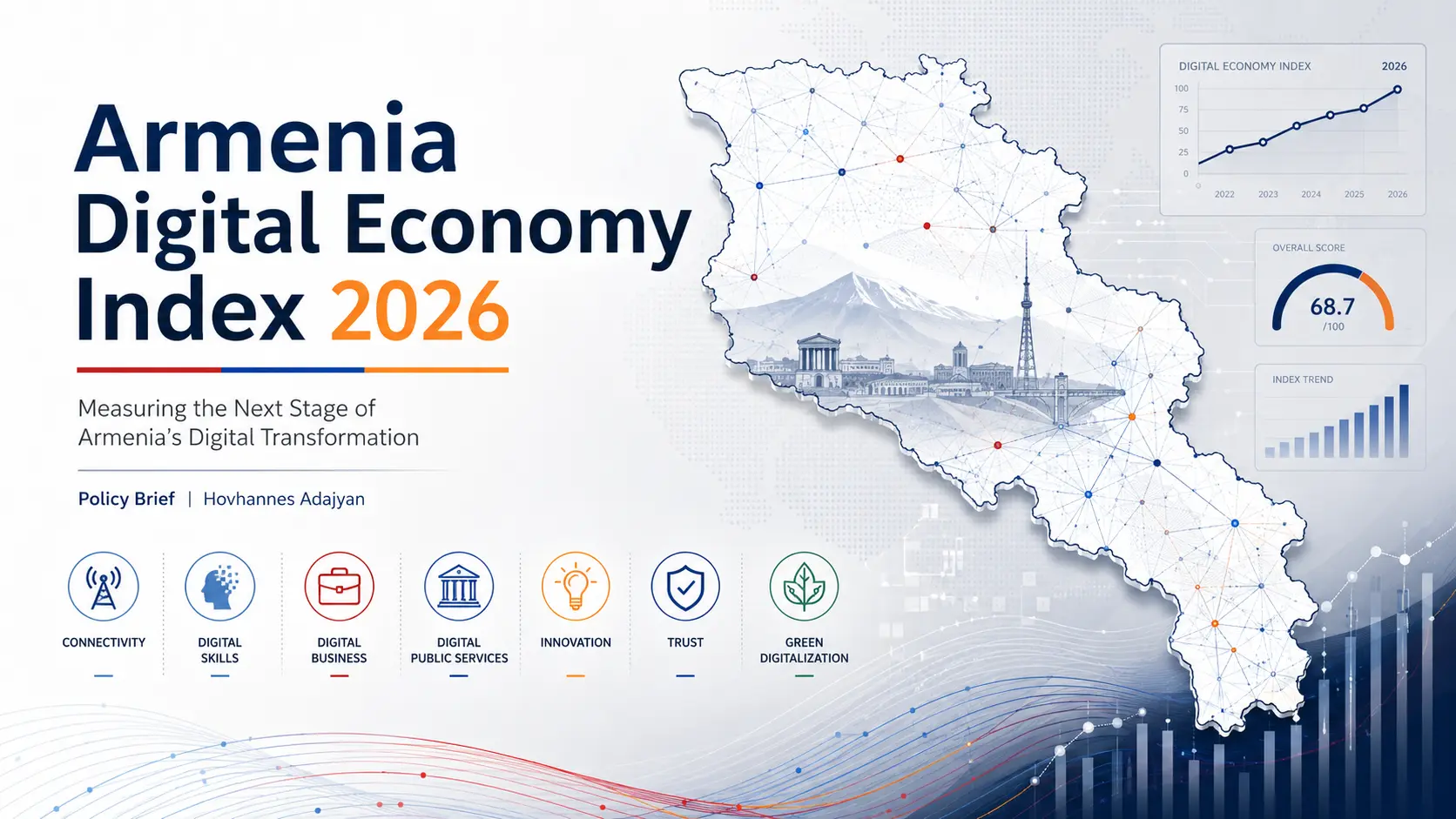
Armenia Digital Economy Index 2026: Measuring the Next Stage of Armenia’s Digital Transformation
Armenia has already built a visible high-tech identity. The country has an active startup ecosystem, growing ICT exports, strong engineering talent, and improving digital public services. However, the next stage of development requires something broader than the growth of the technology sector alone. Armenia now needs to measure how deeply digital technologies are spreading across the whole economy: small and medium-sized enterprises, public administration, education, agriculture, healthcare, environmental management, legal services, and regional communities.
This is the reason for creating the Armenia Digital Economy Index — A-DEI. The purpose of the index is not only to rank Armenia, but to create an annual evidence-based tool that shows where the country is progressing, where gaps remain, and which policy interventions can accelerate digital transformation.
International indexes already provide useful signals. Armenia ranks 62nd out of 127 economies in the Network Readiness Index 2025, with a score of 50.85. Armenia also performs relatively well in connectivity: the ITU ICT Development Index 2025 gives Armenia a score of 86.9, improving from 85.1 in 2023 and 86.4 in 2024.
These results suggest that Armenia is not starting from zero. The country already has a meaningful digital foundation. Yet global rankings also show that digital transformation is uneven. Armenia’s strong points are not always matched by equal progress in digital skills, SME digitalization, cybersecurity, AI readiness, and green digitalization. Therefore, A-DEI should become a national measurement framework that combines international data with Armenia-specific research and stakeholder surveys.
Why Armenia Needs Its Own Digital Economy Index
Most global indexes measure only part of the digital economy. Some focus on connectivity, others on e-government, innovation, AI readiness, cybersecurity, or business environment. These are useful, but they do not fully answer Armenia’s strategic question: is digitalization becoming economy-wide, or is it concentrated mainly in the high-tech sector and public services?
This distinction is important. A country may have good internet coverage and successful tech companies but still have low digital adoption among traditional SMEs. It may have advanced e-government platforms but limited interoperability, low user satisfaction, or weak data-sharing practices. It may have talented engineers but insufficient digital skills among the general workforce, teachers, civil servants, farmers, doctors, lawyers, and small business owners.
The OECD’s Armenia-focused report on business digitalization notes that Armenian SMEs continue to face obstacles including lack of awareness, low digital skills, and financial constraints. This is exactly the type of gap that a national Digital Economy Index should measure. Armenia’s challenge is no longer only to support the ICT sector. The challenge is to help the entire economy use digital tools to increase productivity, improve services, reduce costs, and create new markets.
Proposed Structure of the Armenia Digital Economy Index
The Armenia Digital Economy Index should include seven dimensions:
| Dimension | Weight | What it measures |
|---|---|---|
| Connectivity | 15% | Internet access, broadband, mobile internet, regional digital gaps |
| Digital skills | 15% | Workforce skills, SME skills, public-sector digital capacity |
| Digital business | 20% | SME digitalization, e-commerce, cloud, AI adoption, digital payments |
| Digital public services | 15% | E-government, interoperability, user experience, e-participation |
| Innovation | 15% | Startups, R&D, patents, venture capital, ICT exports |
| Trust | 10% | Cybersecurity, data protection, digital ID, online safety |
| Green digitalization | 10% | Energy use, e-waste, green ICT, circular digital economy |
The index should use a 0–100 scoring system. Each indicator should be normalized, then aggregated into dimension scores, and finally combined into one national A-DEI score.
A-DEI Score = Connectivity × 0.15 + Digital Skills × 0.15 + Digital Business × 0.20 + Digital Public Services × 0.15 + Innovation × 0.15 + Trust × 0.10 + Green Digitalization × 0.10
The largest weight should go to digital business, because the most important transformation challenge is not only government digitalization, but the digitalization of the real economy. If SMEs, farmers, clinics, legal offices, schools, and non-technology companies do not adopt modern digital tools, Armenia’s digital economy will remain narrow.
Armenia’s Position in Global Digital Indexes
International rankings show a mixed but promising picture.
In digital government, Armenia performs strongly. The UN E-Government Development Index 2024 ranks Armenia 48th out of 193 countries, with an EGDI score of 0.8422. Armenia’s E-Participation Index performance is also strong, ranking 27th out of 193. This means Armenia has already built a solid public-sector digitalization base and can position digital government as one of its national strengths.
The World Bank’s GovTech Maturity Index 2025 also places Armenia in Group A — Extensive GovTech Maturity. Group A is the highest category in the World Bank framework and represents economies with normalized GTMI scores of 0.75 or higher. This confirms that Armenia’s public-sector digital transformation has international recognition.
Innovation is another area of progress. In the Global Innovation Index 2025, Armenia ranks 59th among 139 economies. This gives Armenia a credible innovation position, especially for a small country with limited domestic market size. However, innovation capacity must be strengthened beyond individual success stories and must be connected to research, market sophistication, SME digitalization, and export-oriented technology development.
At the same time, the trust and cybersecurity pillar needs more attention. Cybersecurity, data protection, digital identity, and public trust are becoming essential foundations of digital transformation. Digital services cannot scale safely if citizens, businesses, and institutions do not trust the systems they use.
AI readiness is also becoming a strategic issue. For Armenia, this should not be treated only as a technical topic. AI readiness includes data availability, cloud and compute infrastructure, public-sector capacity, AI skills, ethical governance, and sectoral use cases in agriculture, healthcare, education, environment, and law.
What the First A-DEI Baseline May Show
Based on available international data, Armenia’s digital economy profile can be summarized in one sentence:
Armenia has a strong foundation in connectivity, digital government, GovTech maturity, and innovation momentum, but the country’s next challenge is economy-wide digital transformation through SMEs, skills, AI readiness, cybersecurity, and green digitalization.
This conclusion is important for policy. If Armenia wants to become a serious digital economy, the focus should move from “digitalization as websites and online services” to “digitalization as productivity, competitiveness, and resilience.”
A farmer using digital irrigation tools, a clinic using patient navigation and AI-supported triage, a small manufacturer using cloud accounting and e-commerce, or a law office using document automation are all part of the digital economy. The A-DEI should measure this deeper transformation.
Policy Priorities Emerging from the Index
The first A-DEI report should lead to several practical policy directions.
First, Armenia needs a Digital Transformation Voucher Program for SMEs. This could provide small grants or co-financing for cloud services, cybersecurity tools, e-commerce platforms, CRM systems, accounting software, AI assistants, digital marketing, and consulting. Since financial constraints and skills gaps limit SME digitalization, targeted vouchers could become a practical policy response.
Second, Armenia needs a national effort on digital skills beyond the IT sector. The goal should not be only to train programmers. Armenia needs digitally skilled teachers, public servants, SME managers, farmers, doctors, lawyers, municipal employees, and civil society actors.
Third, Armenia should strengthen cybersecurity and digital trust. Digital transformation cannot expand safely if citizens and businesses do not trust online systems. A-DEI should therefore track cybersecurity policy, CERT capacity, data protection enforcement, digital ID adoption, cyber hygiene training, and public awareness.
Fourth, Armenia should connect digitalization with the green and circular economy. This is an underdeveloped area but a promising one. Digital tools can support environmental monitoring, energy efficiency, waste tracking, EV battery reuse, climate-related data systems, and green public procurement.
Conclusion
The Armenia Digital Economy Index can become one of the first flagship products of the Institute of Digital Economy. Its value will be practical: it will help policymakers see where Armenia stands, help businesses understand digital adoption gaps, help international partners identify cooperation opportunities, and help researchers track progress over time.
Armenia already has important advantages: improving connectivity, strong e-government performance, extensive GovTech maturity, and growing innovation visibility. But the next stage is more difficult. It requires digital transformation across the whole economy and society.
The A-DEI can help Armenia move from a successful high-tech narrative to a measurable, inclusive, and evidence-based digital economy strategy.
Sources
Cite this publication
Hovhannes Adajyan. “Armenia Digital Economy Index 2026: Measuring the Next Stage of Armenia’s Digital Transformation.” Institute of Digital Economy, 2026.
Related publications
Tech World: Innovation and Breakthrough Watch
A placeholder publication for technology-world innovations, breakthroughs, and major digital trends.
Institute of Digital Economy Research Team · May 19, 2026 · 4 min read