Agritech: Smart Farming and Food Systems
Hovhannes Adajyan · June 9, 2026 · 8 min read
Abstract
This report explores global smart farming trends and Armenia’s agricultural transformation opportunities, focusing on AI, IoT, smart irrigation, digital Farm ID, land fragmentation, food security, and high-value agricultural development.
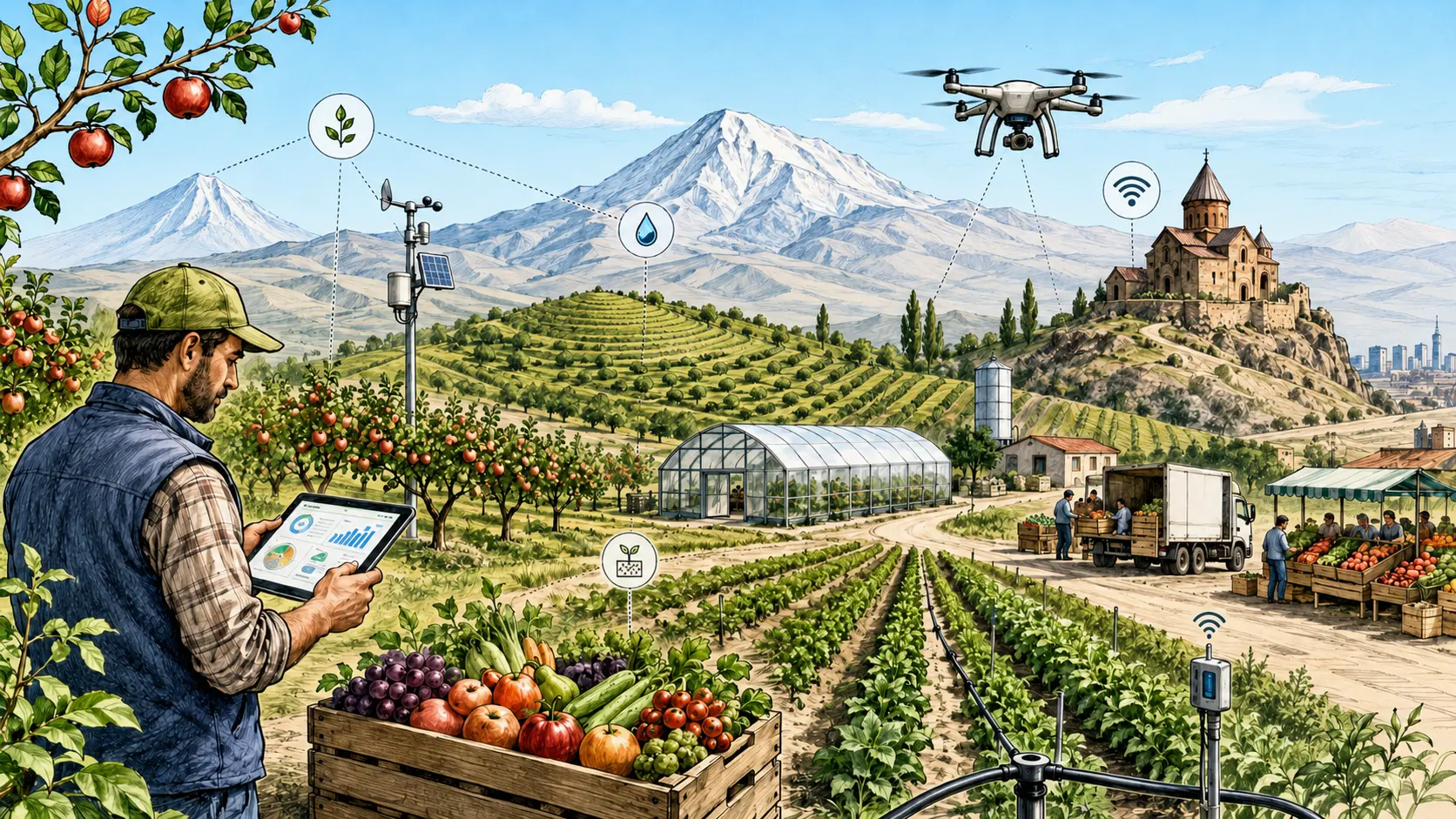
Agritech: Smart Farming and Food Systems
Opportunities for Armenia’s Agricultural Transformation
Introduction
Agriculture is entering a new stage of technological transformation. Around the world, farming is moving from traditional, labor-intensive production toward data-driven, precise, and intelligent systems. This transition is often described as a digital agrarian revolution. It is driven by the need to produce more food with fewer resources, respond to climate change, reduce waste, improve productivity, and make food systems more resilient.
Agritech — the use of digital and advanced technologies in agriculture and food systems — is no longer limited to large industrial farms. Artificial intelligence, Internet of Things sensors, satellite monitoring, drones, robotics, digital farm registries, and smart irrigation systems are becoming important tools for countries seeking to modernize agriculture.
For Armenia, where agriculture remains economically, socially, and regionally important, agritech can become a strategic instrument for rural development, food security, export growth, and environmental sustainability.
The key question is not whether Armenia should digitalize agriculture, but how it can do so in a way that fits the country’s real conditions: small farms, mountainous geography, fragmented land ownership, water scarcity, climate vulnerability, and limited access to modern machinery and finance.
A successful agritech strategy for Armenia should therefore combine global technological trends with locally adapted policy tools.
Global Trends in Smart Farming
Smart farming is based on the idea that agricultural decisions should be supported by data. Instead of applying water, fertilizers, pesticides, or labor equally across a whole field, smart farming uses data to understand the specific needs of each crop, soil zone, animal, or production unit.
This approach is commonly connected with the “five Rs” of precision agriculture: applying the right input, at the right time, in the right place, in the right quantity, and through the right method.
Several technologies are central to this transformation.
First, AI and machine learning are increasingly used for crop disease detection, pest monitoring, yield forecasting, irrigation planning, and market prediction. Image recognition systems can identify plant diseases or pests from photos, allowing farmers to react earlier and reduce losses. Predictive models can analyze weather, soil, and historical production data to estimate yields and support better planning.
Second, IoT sensors are used to monitor soil moisture, temperature, air humidity, livestock health, greenhouse conditions, and irrigation needs. When connected to cloud platforms or mobile applications, these systems give farmers real-time information and help automate decisions.
Third, remote sensing and satellite data allow farms, governments, and researchers to monitor vegetation health, soil salinity, drought stress, and land-use patterns. Satellite systems such as Landsat and Sentinel-2 make it possible to observe agricultural areas at scale and support evidence-based planning.
Fourth, drones and robotics are expanding the possibilities of precision agriculture. Drones can conduct aerial surveillance, identify stressed areas of fields, and support precision spraying. Robotic systems can assist with weeding, harvesting, and soil monitoring.
Technologies such as computer vision-based weed detection can reduce herbicide use by applying chemicals only where weeds are actually present. This can lower production costs and reduce environmental damage.
Finally, agritech is not only about production. It also includes food systems, meaning logistics, storage, processing, traceability, food safety, digital marketplaces, supply-chain optimization, and reduction of post-harvest losses.
For Armenia, this broader view is especially important because the value of agriculture depends not only on what farmers produce, but also on how products are processed, branded, certified, transported, and sold.
Armenian Agriculture: Current Context
Agriculture remains an important part of Armenia’s economy and society. It contributes to GDP, provides employment, supports rural communities, and plays a key role in food security.
Armenia has strong traditions in horticulture, viticulture, livestock, and high-value crops. Grapes, apricots, vegetables, potatoes, wheat, barley, and livestock products remain central to the sector. Armenia’s reputation in wine and brandy production, as well as its potential in fruits, greenhouse products, and aquaculture, create opportunities for higher-value exports.
However, Armenian agriculture also carries a difficult legacy. After the land privatization process of the early 1990s, the sector became dominated by small family farms. This created private ownership and market-oriented agriculture, but it also resulted in high land fragmentation.
Many farms are small, scattered, and difficult to modernize. The average farm size is limited, which makes it harder to use modern machinery, irrigation systems, digital tools, and economies of scale.
The result is a mixed picture: Armenia has strong agricultural potential, but productivity remains constrained by structural limitations. Many farmers still rely on manual labor, outdated machinery, traditional irrigation practices, and limited access to advisory services.
Digital technologies can help address some of these problems, but only if they are introduced through realistic and affordable models.
Key Challenges
The first major challenge is land fragmentation. Small and fragmented land plots reduce efficiency, make mechanization harder, and limit investment. Many modern agritech solutions are designed for larger farms, so Armenia needs cooperative, shared-service, or community-based models to make technology accessible to smallholders.
The second challenge is water scarcity and irrigation inefficiency. Armenia faces climate vulnerability, seasonal water shortages, and aging irrigation infrastructure. Smart irrigation, soil moisture sensors, computer-controlled drip systems, and water-use monitoring can help reduce waste and increase resilience. This is one of the most urgent agritech areas for Armenia.
The third challenge is limited access to finance and modern inputs. Many farmers cannot easily afford sensors, drones, greenhouses, digital platforms, or modern machinery. Even fertilizers and basic inputs can create debt pressure. Therefore, agritech adoption cannot rely only on market forces. It needs public support tools such as vouchers, leasing, subsidized loans, demonstration farms, and shared technology centers.
The fourth challenge is skills and awareness. Digital tools are only useful if farmers understand how to use them. Armenia needs agricultural extension services that combine traditional agronomy with digital literacy. Farmers need practical training, not only theoretical presentations.
The fifth challenge is data fragmentation. Without reliable farm-level data, it is difficult to design targeted support programs, monitor productivity, manage land use, provide crop insurance, or build AI-based advisory services. This makes digital farm identification and agricultural data infrastructure especially important.
Opportunities for Armenia
Despite these challenges, Armenia has strong opportunities to build a modern agritech agenda.
One priority is digital Farm ID. A digital Farm ID system can create a structured digital identity for farms, linking data about land, crops, livestock, machinery, irrigation, support programs, and production history.
This would help government design better policies, reduce administrative burdens, support crop insurance, improve subsidy targeting, and create the foundation for AI-based agricultural services.
Another opportunity is smart irrigation. Because water scarcity is a major risk, Armenia can prioritize computer-controlled drip irrigation, soil moisture sensors, climate-based watering schedules, and remote monitoring of water use. These tools can reduce waste, improve yields, and support climate adaptation.
A third opportunity is high-value horticulture and greenhouse farming. Armenia already has potential in fruits, vegetables, grapes, and intensive orchards. Digital monitoring in greenhouses, automated climate control, pest detection, and precision fertilization can increase productivity and export quality.
A fourth opportunity is wine, brandy, and specialty food systems. Armenia can use digital traceability, quality certification, origin branding, and supply-chain platforms to strengthen its position in premium agricultural markets. This is especially relevant for indigenous grape varieties, dried fruits, organic products, and niche exports.
A fifth opportunity is agricultural drones and remote sensing services. Instead of expecting every farmer to buy drones, Armenia can develop service providers that offer drone-based field monitoring, disease detection, mapping, and spraying services to farmers and cooperatives.
A sixth opportunity is AI-supported advisory services. Mobile-based advisory tools could help farmers with irrigation decisions, disease identification, market prices, weather risks, and input planning. These systems should be developed in Armenian language and adapted to local crops and regions.
Strategic Goals for Armenia
Armenia’s agritech development should serve several national goals.
The first goal is productivity growth. Digital tools should help farmers produce more with fewer resources and lower risks.
The second goal is climate resilience. Agriculture must become better prepared for drought, extreme weather, water stress, and changing growing conditions.
The third goal is rural modernization. Agritech should support rural communities, create new jobs, attract young specialists, and connect villages to innovation ecosystems.
The fourth goal is export competitiveness. Armenia should move from raw or low-value agricultural production toward higher-value, certified, traceable, branded, and processed products.
The fifth goal is food security. Digital agriculture can help Armenia better manage domestic production, especially in strategically important crops and supply chains.
The sixth goal is data-driven governance. Agricultural policy should be based on reliable data, digital registries, farm-level information, and measurable outcomes.
Policy Recommendations
To advance agritech, Armenia should begin with practical and scalable steps.
First, the government and partners should pilot a Digital Farm ID system in selected regions and gradually expand it nationally.
Second, Armenia should create smart irrigation demonstration zones where farmers can see the benefits of sensors, drip systems, and automated watering.
Third, a Digital Agriculture Voucher Program should support small farmers and cooperatives in adopting basic technologies, including sensors, advisory apps, cloud tools, and precision services.
Fourth, Armenia should promote agritech service providers that offer drones, mapping, soil analysis, and AI advisory tools as services rather than products that each farmer must buy.
Fifth, universities, research institutes, and technology companies should work together to create Armenian-language agritech solutions adapted to local crops, climate, and farming practices.
Finally, agritech should be connected with Armenia’s broader digital economy agenda. Smart farming should not be treated as an isolated agricultural topic. It should become part of national digital transformation, innovation policy, regional development, and food-system resilience.
Conclusion
Agritech offers Armenia an opportunity to modernize agriculture without abandoning the realities of smallholder farming and rural communities.
Smart farming, digital Farm ID, AI advisory tools, drones, remote sensing, smart irrigation, and supply-chain digitalization can help Armenia address long-standing challenges such as land fragmentation, water scarcity, low productivity, and limited market access.
The goal should not be technology for technology’s sake. The goal should be a more productive, sustainable, data-driven, and high-value agricultural system.
If Armenia successfully combines digital tools with institutional reforms, farmer education, cooperative models, and targeted public support, agritech can become one of the pillars of the country’s digital economy and regional development strategy.
Sources
- Ministry of Economy of Armenia — Agricultural Sector Development Strategy 2020–2030
- FAO — Armenia at a Glance
- FAO — Armenia Family Farming Country Profile
- FAO — Tackling Land Fragmentation in Armenia through Strategic Land Consolidation
- World Bank — Armenia General Water Security Assessment
- World Bank — Armenia to Strengthen Drinking Water Supply and Irrigation Services
- FAO — Digital Agriculture in Action: Artificial Intelligence for Agriculture
- World Bank — Digital Agriculture Roadmap Playbook
- Copernicus — Sentinel-2 for Agriculture
- FAO AGRIS — Remote Sensing for Precision Agriculture: Sentinel-2 Improved Features and Applications
Cite this publication
Hovhannes Adajyan. “Agritech: Smart Farming and Food Systems.” Institute of Digital Economy, 2026.